

Moving to Canada is exciting but also challenging, like managing money, and for immigrants, having a good credit score is key. It helps get loans, credit cards, and even places to live.

Newcomers without a Canadian credit history find it hard to get financial services. So, how do immigrants start building their credit score in Canada? We’ll share important tips and guide you through the Canadian financial world.
Understanding the Canadian Credit System
It’s key for immigrants to know the Canadian credit system. This system uses your credit history to give you a score. This score shows how well you’ve borrowed and paid back money.
How Credit Scores Work in Canada
In Canada, your credit score comes from your credit history. This history includes your past borrowing and repayment. Lenders use this score to see if you’re trustworthy.
Major Credit Bureaus: Equifax and TransUnion
Canada has two big credit bureaus: Equifax and TransUnion. They gather data on your credit history. This data helps them make your credit score. It’s smart to check your reports from both.
Credit Score Ranges and Their Impact on Financial Opportunities
Credit scores in Canada go from 300 to 900. A higher score means better credit. Scores are divided into ranges like poor, fair, good, very good, and excellent.
Knowing these ranges helps a lot. They affect your chances to get loans, credit cards, and more. By understanding the Canadian credit system, immigrants can make smart choices to boost their scores.
Why Credit Scores Matter for New Immigrants
Credit scores are very important for new immigrants. A good score can help you get into the Canadian economy. It makes it easier to find financial opportunities.
Securing Affordable Housing and Rental Approvals
Landlords check credit scores to decide if you can rent. A better score means better deals and lower deposits. It’s key for new immigrants to have a good credit history for housing.
Qualifying for Loans, Credit Cards, and Mortgages
A good credit score helps you get loans and lower rates. This is important for buying a car or a home. Banks see people with good scores as safer, making it easier to get credit.

How Employers and Service Providers Use Credit Information
Some employers and service providers look at credit scores. This is more common in some jobs. But it shows how credit scores affect more than just money matters. Keeping a good score can make you look better financially.
In short, credit scores are very important for new immigrants. They affect housing, money chances, and even jobs. By knowing and managing their scores, new immigrants can do better in Canada.
Credit Challenges Unique to Immigrants in Canada
Immigrants in Canada face a big challenge. They can’t bring their credit history from their home country. This is because lenders in Canada can’t share financial info from other countries.
Non-Transferable International Credit History
There’s no way to share credit info between countries. So, immigrants must start over. This is hard for those with a long credit history in their home country.
Documentation and Identification Requirements
Immigrants struggle to meet the needed documents for credit in Canada. Here’s a list of important documents:
| Document Type | Purpose | Issuing Authority |
| Passport | Proof of Identity | Government of the immigrant’s home country |
| Work Permit | Proof of Authorization to Work in Canada | Immigration, Refugees and Citizenship Canada |
| Proof of Address | Utility bills or lease agreements | Various Canadian institutions |
Overcoming Language and Cultural Banking Differences
Language and banking differences can make it hard for immigrants. But, banks offer special help for newcomers. This can make things easier.
First Steps to Establishing Credit as a Newcomer
Starting to build credit in Canada as a newcomer is easier than it seems. The first step is to lay the groundwork. This will help with your financial activities in Canada.
Opening Your First Canadian Bank Account: Required Documents
Getting a Canadian bank account is a big first step. It helps you manage money and start a relationship with a bank. This makes it easier to use their services and products later.
To open an account, you need ID and proof of where you live. You might need a passport, visa, or immigration papers. Also, a utility bill or lease can prove your address.

Obtaining a Social Insurance Number and Government ID
A Social Insurance Number (SIN) is key for working and getting government services in Canada. To get a SIN, visit a Service Canada office with your immigration papers and ID. Also, getting a government ID like a driver’s license helps prove who you are in Canada.
Leveraging Newcomer Banking Programs at Major Institutions
Many big Canadian banks have programs for newcomers. These programs offer benefits like no fees, free international money transfers, and credit products. For example, some banks have accounts for newcomers with credit cards or loans.
By taking these first steps, newcomers can start building credit in Canada. It’s about starting and using the resources available to build a strong financial base.
How to Build Credit Score in Canada for Immigrants in 2026
In 2026, building a credit score in Canada as an immigrant is new. We use digital tools and financial tech now. Old ways are not enough for newcomers.
Digital-First Credit Building Strategies for the New Economy
Digital-first ways change how immigrants get credit scores in Canada. Online banking and apps help manage money and pay on time.
Some key digital-first strategies include:
- Using digital banking platforms to monitor accounts and transactions
- Setting up automatic payments for bills and loans
- Leveraging budgeting apps to track expenses

Navigating Post-Pandemic Credit Requirements
After the pandemic, credit rules changed. Lenders are more careful. Immigrants need to show they can handle money well.
To meet post-pandemic credit needs, try:
- Maintaining a stable income and employment history
- Avoiding multiple credit inquiries within a short period
- Keeping credit utilization ratios low
Leveraging New Fintech Solutions for Faster Credit Building
Fintech helps immigrants build credit fast. These platforms use new ways to score credit and make applying easier.
Open Banking Initiatives and Their Benefits for Newcomers
Open banking lets you share financial info safely. This helps lenders see your true credit worth. For newcomers, this means:
| Benefits | Description | Impact on Credit Score |
| Enhanced Credit Scoring | More accurate credit assessments using diverse data points | Positive |
| Streamlined Applications | Faster processing of credit applications | Faster Approval |
| Personalized Financial Products | Tailored credit products based on individual financial profiles | Better Matching |
By using these new strategies, immigrants in Canada can build a strong credit base in 2026 and later.
Secured Credit Cards: Your Gateway to Canadian Credit
Immigrants can start their Canadian credit journey with secured credit cards. These cards are perfect for those with little to no credit history. They are a great choice for newcomers.

Top Secured Card Options with Low Deposit Requirements
When picking a secured credit card, look for ones with low deposit needs. Some banks ask for as little as $500. Big banks like TD and RBC have special packages for newcomers that include these cards.
- TD Secured Card: Requires a minimum $500 deposit.
- RBC Secured Visa Card: Offers a simple application process.
Maximizing Secured Cards for Credit Growth
To grow your credit with a secured card, pay on time and keep your balance low. Paying on time shows you’re responsible. This is good for your credit score.
Also, check your credit report often. This helps you see how you’re doing and find any mistakes.
Graduation Strategies: Moving from Secured to Unsecured Cards
Once you have good credit with a secured card, you might get an unsecured card. This means you’ve shown you can handle credit well. You’ll need to make payments on time and keep your balance low.
Banks check your account sometimes. If you’re doing well, they might give you an unsecured card.
Newcomer Banking Packages and Credit-Building Programs
Canada’s big banks have special banking packages for newcomers. These packages help immigrants start strong financially in their new home.
RBC, TD, and CIBC Newcomer Advantages Compared
The Big Three banks in Canada – RBC, TD, and CIBC – have great newcomer banking packages. Here’s what makes each one special:
| Bank | Package Name | Key Features | Credit-Building Opportunities |
| RBC | RBC Newcomer Banking Package | No monthly fees for 1 year, unlimited transactions | Secured credit card options |
| TD | TD Newcomer Banking Package | $0 monthly fees for 1 year, access to TD’s financial planning tools | TD Secured Credit Card, credit-builder loans |
| CIBC | CIBC Newcomer Advantage | No monthly fees for 1 year, CIBC Smart Investor Plan | CIBC Secured Credit Card, personalized financial advice |
Credit-Builder Loans and Their Impact on Your Score
Credit-builder loans help build credit. You make regular payments for a set time. After that, you get the loan money back. Making payments helps build a good credit history.

Specialized Immigrant Financial Services and Education
Many banks offer special services and education for immigrants. They have programs on money management, credit advice, and more. These are designed to help newcomers.
Using these banking packages and credit-building programs, newcomers can build a strong financial base in Canada.
Provincial Differences in Credit Building Opportunities
When newcomers move to different Canadian provinces, they find different ways to build credit. This is because of local economic conditions, financial resources, and rules.
Urban Credit Building Advantages
Places like Toronto and Vancouver in Ontario and British Columbia have lots of financial services. Newcomers there can find many ways to build credit, like big banks and new tech services.
Unique Credit System Considerations
Quebec’s credit system is different, with its own scoring model. It’s important for newcomers to know this to build credit well in Quebec.
Prairie and Atlantic Provinces Credit Resources
The Prairie Provinces (Alberta, Saskatchewan, Manitoba) and Atlantic Canada (Nova Scotia, New Brunswick, Prince Edward Island, Newfoundland and Labrador) have their own credit building ways. They might not have as many financial services as Ontario or British Columbia. But, they offer special chances through local credit unions and community banks.
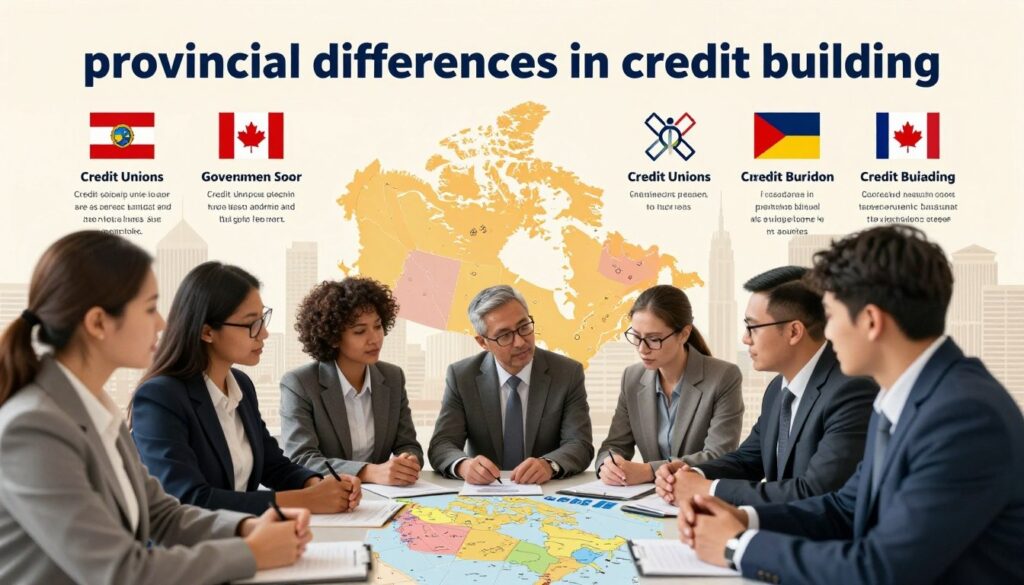
It’s important to know about these differences to build credit well. Newcomers should look into the credit scene of their province to find the best chances.
Alternative Credit-Building Methods
Newcomers to Canada can use new ways to improve their money status. These new methods help immigrants build a good credit score.
Rent Reporting Services That Build Your Credit Profile
Rent reporting services are now a big help. They report rent payments to credit agencies. This shows that you can handle money well.
Companies like FrontLobby and RentTrack make this easy. They let you build credit by paying rent on time.
Using Utility and Telecom Payment History
Using utility and telecom payments is another smart move. Some services add these payments to your credit report. This gives a full picture of your money habits.

Building Credit Through Authorized User Status
Being an authorized user is another way to build credit. When you’re added to a credit card, you get to use the good credit of the person who owns it. This helps improve your own credit score.
New Credit-Building Apps and Services for 2026
New apps and services are coming in 2026. They will help immigrants build credit in new ways. These apps track and report on different money activities.
| Credit-Building Method | Description | Benefits |
| Rent Reporting Services | Report rental payments to credit bureaus | Helps demonstrate creditworthiness through rent payments |
| Utility and Telecom Payments | Incorporate utility and telecom payments into credit reports | Provides a broader view of credit behavior |
| Authorized User Status | Become an authorized user on someone else’s credit account | Benefits from the account holder’s good credit habits |
Digital Tools and AI for Credit Monitoring in 2026
In 2026, credit monitoring is changing a lot. This is thanks to new digital tools and AI. Immigrants in Canada are finding it easier to manage their credit scores.

Automated credit improvement platforms are now available. They use AI to look at credit reports and suggest how to get better scores. This helps users make smart financial choices.
Automated Credit Improvement Platforms
These platforms make managing credit simpler. They use AI to give advice on how to boost credit scores. This helps immigrants make good financial decisions.
Predictive Credit Score Technology
Predictive credit score tech is also new. It uses past data and AI to guess future credit scores. This lets people take steps to keep or improve their credit health.
Mobile Banking Features for Immigrants
Mobile banking for immigrants is getting better too. It includes support in many languages, easy account management, and alerts for transactions. This makes it simpler for newcomers to use Canadian banks.
By using these digital tools and AI, immigrants in Canada can better watch and improve their credit scores. This opens up more financial chances in 2026.
Immigration Status and Its Impact on Credit Building
Immigration status is key in Canada for building credit. Each immigration type affects creditworthiness and access to money services.
Permanent Residents vs. Work Permit Holders: Credit Differences
Permanent residents and work permit holders face different credit challenges. Permanent residents find it easier to get credit because they are here for the long term.
- Permanent residents can more easily obtain credit cards and loans.
- Work permit holders may face more challenges due to the temporary nature of their status.
- Some lenders offer specialized products for work permit holders, but options may be limited.
International Students: Special Credit Considerations
International students have special credit challenges in Canada. They start from zero without a Canadian credit history.
- Some banks offer student credit cards or lines of credit.
- Students may need a co-signer who is a Canadian resident.
- Building a positive credit history is key for future money chances.
Transitioning from Temporary to Permanent Status
People moving from temporary to permanent status can boost their credit.
- Having a steady income and paying on time helps.
- Checking credit reports for mistakes is important during status changes.
- Getting financial advice can help with the transition.

Recovering from Credit Mistakes and Setbacks
When credit mistakes happen, immigrants can fix them. Mistakes like late payments or high credit use can hurt your score. But, with the right steps, you can fix these and build a good credit score.
Addressing Late Payments and Collections
One big mistake is late payments. This can really hurt your score. To fix it, pay on time from now on. If you’ve missed payments, talk to your creditors about a payment plan.
You can also ask creditors to remove late marks from your report if you’ve paid up.
Credit Rehabilitation Programs for Immigrants
Credit rehab programs help fix credit mistakes. They give advice to improve your score. For immigrants, these programs can be very helpful. They offer advice for the Canadian credit system.
Working with Credit Counselors Who Understand Immigrant Needs
Getting help from a credit counselor who gets immigrant issues is key. They can help with debt, score improvement, and the Canadian financial system. They also help plan to avoid future mistakes.
Fixing credit mistakes takes time and the right help. By fixing late payments, using rehab programs, and getting help from credit counselors, immigrants can get back on track. They can achieve a good credit score.
Timeline Expectations: Realistic Credit Building Goals
Building credit takes time. It has big steps at different times. Knowing these steps helps you plan better and make smart money choices.
First 6 Months: Establishing Basic Credit Foundations
The first six months are for setting up your credit basics. You need to open a Canadian bank account. Also, get a secured credit card. Make sure your credit reports are right with Equifax and TransUnion.
6-18 Months: Building to a Good Credit Score
From 6 to 18 months, your good habits start to show. Pay your secured credit card on time. You might also get a credit-builder loan. This time is key to showing you’re reliable with money.
18+ Months: Achieving Excellent Credit as a New Canadian
After 18 months, keep being careful with money. You’ll get a top credit score. This means better loan deals and more credit options. It’s also a good time to check your credit reports for mistakes.
Here’s a table showing how credit scores change over time:
| Timeframe | Credit Score Range | Key Actions |
| 0-6 Months | Poor to Fair (300-600) | Open bank account, apply for secured credit card |
| 6-18 Months | Fair to Good (600-700) | Make timely payments, consider credit-builder loan |
| 18+ Months | Good to Excellent (700+) | Continue timely payments, monitor credit reports |
Knowing how to build credit helps new Canadians. It lets you set goals and work towards financial stability.
Conclusion
Building credit in Canada is key for newcomers. It helps them start strong financially. Knowing the Canadian credit system and using smart strategies can open doors to better money chances.
Getting a good credit score takes time and effort. It’s important to start small. Open a Canadian bank account and use secured credit cards to begin.
With the right plan, you can build a strong credit score. This article shows how. By following these steps, you can get better loans, credit cards, and even rent apartments. Begin your credit-building journey now for a brighter future.