

The Colonel in Disguise
He thought removing her patch would break her—until four black hawks landed
Staff Sergeant Brennan walked through the mess hall like he owned the lease on the building. You know the type—chest puffed out, voice just a little too loud, eyes scanning the room for someone to intimidate. He thrived on it. The evening chow crowd was thick, a sea of green camouflage and tired faces, soldiers just wanting to eat their spaghetti and forget about the motor pool for an hour.
Brennan didn’t want peace. He wanted entertainment.
His eyes locked onto a solitary figure in the far back corner—a female soldier sitting alone. She wasn’t scrolling on her phone like everyone else. She was reading a thick, hardcover technical manual while picking at a salad.
“Look at that,” Brennan nudged Corporal Rodriguez, a smirk spreading across his face. “The library is open.”
I was sitting three tables away. I saw the whole thing start. I’m Corporal Martinez, by the way. I work in Admin, so I make it my business to notice things. And something about that woman in the corner bothered me—not in a bad way, but in a different way.
She sat too still. In a room full of people shifting, chewing, and laughing, she was a statue.
Brennan and his little entourage of “yes-men” beelined for her. Their boots clomped heavy on the linoleum. The noise around them started to dip. Soldiers have a sixth sense for drama; we can smell a confrontation brewing before a word is spoken.
The First Strike
Brennan stopped right behind her, close enough that his shadow fell across the pages of her book. She didn’t turn around. She just turned a page. The diagram on the paper looked like a schematic for a drone guidance system, not the usual field manuals we studied.
“You know,” Brennan announced, his voice booming so the surrounding tables would hear him, “some patches have to be earned the hard way.”
She kept reading.
“Others,” Brennan leaned down, his breath probably hot on her neck, “just get handed out like participation trophies because the Army needs to fill a quota.”
Slowly, deliberately, she closed the book. She lined it up perfectly parallel with her tray. When she finally looked up, Brennan was grinning. He expected fear. He expected her to jump up and apologize, or stutter.
Instead, she looked at him with eyes that were completely empty. Not dead—empty. Like a camera lens zooming in. No fear. No surprise. Just data collection.
“Can I help you, Staff Sergeant?” Her voice was level.
Brennan reached down and grabbed the edge of the combat patch on her right shoulder—a deployment patch, signifying she’d served in a combat zone.
“I don’t think you earned this,” Brennan spat.
With a sharp, violent jerk, he ripped the patch off her uniform.
ZZZRRRRRIP.
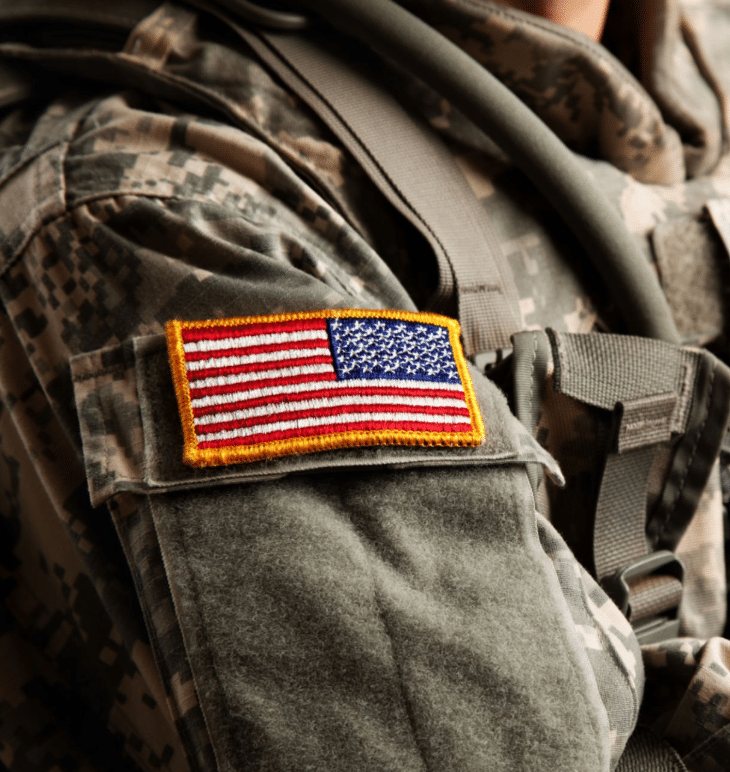
The sound was excruciatingly loud in the sudden quiet of the hall. It echoed. Heads turned from fifty feet away.
The Calm Before the Storm
Brennan held the fabric up in the air, waving it around like he’d just captured an enemy flag. “Amazon Prime delivers fast these days, huh? Did you buy this to look cool for your boyfriend?”
The female soldier stood up. The air in the room grew heavy. I stopped chewing. My heart was hammering, and I wasn’t even the one involved. I waited for her to yell, to demand it back, to call for an officer.
She didn’t do any of that.
She looked at the bare velcro on her shoulder, then at the patch in Brennan’s hand, and finally at his face. She studied him for maybe five seconds.
“Are you finished, Staff Sergeant?”
That was it. That was all she said.
Brennan blinked. The lack of reaction threw him off script. “Yeah. I’m finished exposing a fake. Get out of my mess hall.”
She nodded once—a sharp, military nod. She picked up her tray, tucked her manual under her arm, and walked past him. She didn’t hurry. She didn’t look down. She walked with a rhythm that was almost hypnotic.
Most of the room chuckled nervously, glad the tension was over. But I couldn’t laugh. I was staring at the patch on the table, thinking about the way she walked out the door.
People who are humiliated publicly don’t act like that. People who are guilty don’t act like that. Only people who are holding four Aces and a King act like that.
I had a sinking feeling Staff Sergeant Brennan had just made the last mistake of his career.
The Digital Investigation
I couldn’t shake it. All night, I lay in my bunk staring at the ceiling. The image of her face—that absolute, terrifying calmness—kept replaying in my mind.
The next morning, I decided to do a little digging. I work in the S-1 Administrative Shop. I handle paperwork, transfer orders, and personnel files. It gives you access to information.
I typed in the search query. I didn’t know her name, so I had to search by unit assignment. Logistic Support, 45th Battalion. There she was.
Specialist Hayes, Sarah.
Rank: E-4 (Specialist). Time in Service: 18 months. MOS: 92A – Automated Logistical Specialist.
On the surface, she was nobody. A standard, low-ranking supply soldier. Just like Brennan said. But then I looked closer at the screen.
Her education block listed a Master’s Degree in Aerospace Engineering.
I frowned. Why is someone with a Master’s degree stacking boxes in a warehouse as a Specialist? She should be an officer, or at least working in a tech field.
I scrolled down to her physical fitness scores. 300/300. Maxed out. Run time: 11:45 for two miles. Pushups: Max. Situps: Max.
I decided to check her previous duty stations. If she had a combat patch, she must have deployed. I clicked on the “History” tab.
The screen flickered. A red box popped up.
ACCESS DENIED. AUTHORIZATION CODE ALPHA-ONE REQUIRED.
I’d never seen that before. Usually, if I don’t have access, it just says “Restricted.” I tried to access her awards file.
ACCESS DENIED. CONTACT OFFICE OF THE INSPECTOR GENERAL.
My stomach dropped. Alpha-One clearance is reserved for people who work in places that don’t officially exist.
The Escalation
Over the next few days, the harassment went from “mean” to “systematic.” Brennan and his goons were following her everywhere. When she went to the chow hall, they took all the seats at her table. When she went to the gym, they occupied the equipment she was using. When she walked back to the barracks, they walked five feet behind her, making loud comments about “stolen valor” and “fake heroes.”
But what terrified me was her reaction—or the lack of it. She never snapped. She never cried. She adapted. When they blocked the door, she used the side entrance. When they took the equipment, she used bodyweight exercises. She was fluid, like water flowing around a rock.
But I noticed something else. Every time they cornered her, she checked the exits. Every time they approached, she shifted her feet into a combat stance—subtle, barely visible, but ready. Her hands were never in her pockets. Her eyes were always tracking.
She was documenting. She was building a case file in her head. And she was waiting for them to make a physical mistake.
During one incident in the motor pool, she diagnosed a hydraulic failure in a military transport truck by ear alone—something that should have been impossible for a supply clerk. Staff Sergeant Williams, the motor sergeant, was amazed.
“You saved this truck, Hayes,” Williams said, staring at the leaking fluid that her diagnosis had revealed.
Brennan’s face turned red with rage. “She got lucky. She probably loosened it herself when nobody was looking. Sabotage.”
Hayes picked up her clipboard, wrote down the part number for the replacement seal, and handed it to the stunned motor sergeant. “I recommend replacing the entire line, Sergeant. The vibration likely caused micro-fractures in the coupling.”
As she walked past Brennan, he stepped into her path. “You think showing me up makes you safe? You just painted a target on your back, sweetheart.”
Hayes looked at his boots, then his belt, then his eyes. “Targets are only dangerous if you know how to hit them, Staff Sergeant.”
The Secret of the Patch
That night, I examined the patch Brennan had ripped off. He’d tossed it on a table in the orderly room like it was garbage. I picked it up when no one was looking.
Under a magnifying glass, the truth became clear. Standard Army patches are mass-produced polyester with loose weave. This patch was high-density nylon with something extraordinary—tiny, almost invisible strands of silver thread woven into the backing.
Glint Tape hybrid. Designed to reflect infrared lasers. Under night vision goggles, these patches glow like neon signs, but they look like black fabric to the naked eye. These aren’t sold anywhere. They’re issued to Tier-1 operators—Delta Force, SEAL Team 6, Regimental Reconnaissance.
Each one costs about two thousand dollars to manufacture because of the specific IR frequency tuning. Brennan had ripped a classified piece of technology off a woman’s shoulder and called it a “participation trophy.”
I tried to warn him. I approached him the next morning outside the company headquarters.
“Staff Sergeant, I looked at that patch you tore off. It’s not fake. It has IR threading. It’s real. High-speed gear. And her file… it’s classified above Secret.”
Brennan stepped into my personal space. “Let me tell you something, Martinez. I’ve been in this Army for eight years. I know a fraud when I see one. And if you take her side, I’ll bury you right next to her.”
There was no reasoning with him. His ego was driving the car, and he had cut the brake lines.
That afternoon, my phone rang. It was an external line. “Corporal Martinez? This is Colonel Thompson, Division G-3. We are aware of the situation. Listen carefully—do not intervene. Do not warn him again. We need him to commit. We need the evidence to be irrefutable.”
My blood went cold. “Sir, what exactly is happening here?”
“Leadership stress test,” Thompson said. “Specialist Hayes volunteered for this assignment. She’s documenting every interaction. But we need him to cross a line he can’t walk back from. Stay out of it, Corporal. That’s an order.”
The line went dead.
The Harassment Intensifies
The next week was brutal to watch. Brennan’s crew ramped up their campaign. They “accidentally” spilled food on her uniform. They hid her gear before inspections. They spread rumors that she was sleeping with officers to get promoted.
Hayes absorbed it all like she was made of stone. She documented every incident in a small green notebook she kept in her cargo pocket. She never raised her voice. She never fought back. She just recorded.
One afternoon, I saw Corporal Rodriguez corner her in the supply room. He got close, too close, invading her personal space in a way that made my skin crawl.
“You know what I think?” Rodriguez said, his voice low and threatening. “I think you’re scared. I think you know we’re onto you, and you’re just waiting for the right moment to run.”
Hayes looked at him with those empty eyes. “The only thing I’m waiting for, Corporal, is for you to touch me. Please. I would love that.”
The way she said it—calm, almost eager—made Rodriguez step back like he’d been slapped. There was something in her voice that didn’t match her rank. It was the voice of someone who had been in situations where violence was the language, not the exception.
Rodriguez left without another word.
That night, I saw her in the gym. It was late, past 2100 hours, and the place was empty except for her. She wasn’t doing regular PT. She was running through hand-to-hand combat drills—precise, efficient movements that looked more like ballet than fighting. Every strike ended at a vital point: throat, temple, solar plexus, kidney.
She wasn’t practicing to defend herself.
She was practicing to end threats.
The Friday Morning Trap
Friday morning, Brennan organized a “special” formation. He claimed it was for uniform inspection, but everyone knew the truth. It was a public execution. He had gathered three platoons—about 120 soldiers—on the parade deck.
He placed Specialist Hayes right in the front row, center.
Brennan walked down the line, his boots crunching on the gravel. He stopped in front of her.
“Specialist Hayes, I’ve been doing some checking. Your service record seems… incomplete.”
“My records are on file at S-1, Staff Sergeant.”
“I called Personnel Command yesterday. I told them I suspected a case of Stolen Valor in my ranks.” Brennan was playing to the crowd now. “I’m confiscating this unauthorized insignia until you can prove you earned it.”
He reached for the new patch she’d sewn on—an identical replacement to the one he’d torn off.
“Staff Sergeant,” Hayes’ voice dropped an octave. “Do not touch my uniform.”
It was a direct order. It didn’t sound like a Specialist talking to a Sergeant. It sounded like a parent talking to a toddler holding a fork near a power outlet.
Brennan grabbed her shoulder. Hard. He didn’t just touch the patch; he shoved her, trying to make her stumble. It was assault, plain and simple.
Hayes didn’t stumble. She absorbed the force like she was made of granite. She slowly turned her head to look at his hand gripping her uniform.
“Strike one,” she whispered.
Brennan laughed. “Strike one? What are you going to do, write me up? You’re nobody.”
“You have assaulted a superior officer,” Hayes said, projecting now so the entire formation could hear. “Remove your hand immediately.”
Brennan laughed maniacally. “Superior officer? You’re delusional! You’re an E-4!”
Hayes reached into her cargo pocket. For a moment, I thought she was going for a weapon. Instead, she pulled out her phone.
“This conversation is being recorded,” she said calmly. “And transmitted in real-time to the Inspector General’s office. You have ten seconds to remove your hand before I add resisting a lawful order to your charges.”
Brennan’s face went white, then red, then purple. But he didn’t let go. His ego wouldn’t let him.
“Ten,” Hayes said.
“You’re bluffing.”
“Nine.”
The formation was dead silent. You could hear people breathing.
“Eight.”
Rodriguez stepped forward. “Brennan, man, let her go.”
“Shut up!” Brennan screamed. “She’s playing games!”
“Seven.”
“I’m not scared of you!” Brennan squeezed harder.
“Six.”
Then we heard it. At first, just a vibration in the soles of our boots. A low thrumming sound, like a heartbeat speeding up.
Thump-thump-thump-thump.
The Black Hawks Arrive
The roar was deafening. Four black shapes appeared on the horizon, coming in fast, flying low. They weren’t training choppers. They were UH-60 Black Hawks, painted matte black, flying in an attack wedge.
The lead helicopter flared aggressively right over the parade deck, kicking up a dust storm that made half the formation cover their faces. The side door slid open before the wheels even settled. Soldiers jumped out—but these weren’t regular infantry. They were wearing full dress uniforms. Green suits, berets, ribbons flashing in the sun.
Four Full-Bird Colonels marched through the dust cloud, led by a woman with the brassard of the Inspector General on her arm. Behind her was the Provost Marshal, the Division G-1, and the Division Intelligence Officer.
This wasn’t a visit. This was a raid.
The Inspector General—Colonel Williams—stopped five feet from Brennan. Her face was carved from ice.
“Staff Sergeant Brennan? You are relieved of your duties, effective immediately.”
Brennan’s hand finally released Hayes’ shoulder. He stumbled back, mouth opening and closing like a fish.
“Ma’am? I don’t understand. I was just conducting a uniform inspection—”
“Silence,” Colonel Williams commanded.
She turned slightly. “Colonel Hayes?”
My heart stopped. The entire formation gasped.
“Specialist,” Colonel Williams said, her voice softening just a fraction. “End of Mission. Status Report.”
Sarah Hayes broke the Position of Attention. She rolled her shoulders, shedding the mask she’d worn for weeks. The “confused private” was gone. Standing there was a predator.
“Mission complete, Ma’am. Command Climate Assessment finalized. Findings: Critical failure of NCO leadership. Systemic harassment. Pattern of discrimination. And assault on a Superior Commissioned Officer.”
Hayes reached into her cargo pocket and pulled out a velcro patch—not the unit patch Brennan had ripped off, but a rank insignia. A silver eagle. She slapped it onto the center of her chest.
“I am Colonel Sarah Hayes, J-3 Operations, Special Activities Division. I have been undercover in this unit for eight weeks conducting a stress test on leadership integrity.”
The Reckoning
Brennan’s knees buckled. He grabbed the soldier next to him to stay upright. “C-Colonel?” he whispered.
“You failed, Staff Sergeant,” Hayes said softly. “You failed in every way a soldier can fail.”
The Provost Marshal stepped forward with two massive Military Police officers carrying zip-ties. “Staff Sergeant Brennan, you are under arrest for Article 90: Assaulting a Superior Commissioned Officer. Article 93: Cruelty and Maltreatment. Article 107: False Official Statements. And Article 134: Conduct Prejudicial to Good Order and Discipline.”
“Wait!” Brennan screamed as the MPs grabbed his arms. “I didn’t know! Nobody told me! She was wearing a Specialist rank! It’s entrapment!”
Colonel Hayes watched them zip-tie his wrists behind his back. She didn’t look happy. She didn’t look triumphant. She looked disappointed.
“Integrity isn’t about what you do when a Colonel is watching, Staff Sergeant. It’s about how you treat the Specialist when you think nobody is watching.”
She stepped closer to him, her voice dropping so only Brennan, the MPs, and those of us nearest could hear.
“I wore the lowest rank in this formation,” she said. “I made myself vulnerable. I gave you every opportunity to be a leader, to be a protector, to be what an NCO is supposed to be. Instead, you became a predator. You didn’t just fail the test, Brennan. You revealed who you really are when you think you have power over someone weaker.”
The MPs began walking him toward the Black Hawk. Brennan was crying now, ugly sobs that echoed across the silent formation.
“Please,” he begged, twisting to look back at Hayes. “I have a family. I have a career. Please, Colonel, I’m sorry. I’ll do anything.”
Hayes’ expression didn’t change. “You had a family. You had a career. You threw them away the moment you decided humiliating a junior soldier was more important than doing your job.”
The MPs threw Brennan into the back of the Black Hawk. The door slid shut with a metallic clang that sounded like a cell door closing.
Colonel Williams turned to face the formation. Every soldier snapped to attention so fast you could hear the collective sound of boot heels hitting gravel.
“Let me be crystal clear,” Williams said, her voice carrying across the entire parade deck. “What you witnessed here was not entrapment. It was accountability. Colonel Hayes volunteered for an assignment that required her to put her safety, her dignity, and her career on the line to expose toxic leadership. She endured weeks of harassment that would have broken most soldiers. And she did it because we needed to know who in this unit could be trusted with power.”
She paused, letting that sink in.
“Staff Sergeant Brennan is not the only one under investigation. Every NCO and officer who witnessed his behavior and did nothing is now under review. Every soldier who participated in the harassment will face consequences. And every leader who created the environment where this was allowed to happen will be held accountable.”
A ripple went through the formation. People were looking at each other, suddenly terrified.
“You have seventy-two hours,” Williams continued. “If you participated, witnessed, or enabled any form of harassment, discrimination, or abuse during Colonel Hayes’ time in this unit, you will report to the Inspector General’s office and provide a sworn statement. Cooperation will be noted. Silence will be considered obstruction.”
She turned to Hayes. “Colonel, anything to add?”
Hayes stepped forward. When she spoke, her voice wasn’t angry. It was sad.
“I didn’t want to find what I found here,” she said. “I wanted to walk into this unit and see leaders taking care of soldiers. I wanted to be wrong about the reports we’d been receiving. But instead, I found a command climate so toxic that junior soldiers were afraid to eat in the mess hall. I found NCOs using their rank to bully instead of build. And I found officers who were too comfortable to care.”
She looked directly at our Company Commander, who was standing off to the side looking like he wanted to disappear into the ground.
“Some of you will lose your careers over this,” Hayes said. “And you should. Because you failed at the most basic task of military leadership: taking care of your people. You forgot that every soldier in this formation is someone’s son, daughter, brother, sister. They volunteered to serve their country, and you treated them like targets for your entertainment.”
The silence was crushing.
“Dismissed,” Williams said.
The formation scattered like someone had fired a starting pistol. But I didn’t move. I stood there, watching Colonel Hayes as she walked back toward the Black Hawks with the other senior officers.
The Conversation
“Corporal Martinez.”
I jumped. Colonel Hayes was standing right in front of me. Up close, I could see the exhaustion in her eyes—the kind that comes from weeks of pretending to be someone you’re not.
“Ma’am.”
“Walk with me,” she said.
We walked away from the parade deck, toward the motor pool where everything was quiet. She stopped next to a Humvee and leaned against it, suddenly looking very human.
“You knew,” she said. It wasn’t a question.
“Not at first, Ma’am. But I saw the file. I saw the patch. And I saw the way you moved. Nobody with eighteen months in service moves like that.”
She smiled—a genuine smile this time. “What gave it away?”
“The hydraulic diagnosis,” I said. “No 92A knows that. And the way you checked exits. And the fact that you never, not once, looked scared.”
Hayes nodded. “Fear is useful. But only if you control it. I needed them to think I was weak so they’d reveal themselves. The moment I fought back, they would have stopped. And then I wouldn’t have had evidence of the pattern.”
“Was it worth it?” I asked. “Eight weeks of being treated like that?”
She was quiet for a long moment. “Brennan sexually harassed three female soldiers last year. Two of them filed complaints. Both complaints disappeared. One of those soldiers tried to kill herself. She’s alive, but she’s out of the Army now, medically retired with PTSD.”
My stomach turned. “Jesus.”
“The command climate here was so toxic that junior soldiers were too afraid to report abuse because they knew nothing would happen,” Hayes said. “We couldn’t fix it from the top down because the rot was in the middle—in the NCO corps. So we had to document it from the bottom up.”
She looked at me. “You tried to warn him. Even after Colonel Thompson told you to stand down. Why?”
I thought about it. “Because nobody deserves to be set up, Ma’am. Even an asshole.”
Hayes laughed—short and sharp. “He wasn’t set up, Corporal. He set himself up. I gave him a hundred chances to be decent. He chose cruelty every single time. That’s not entrapment. That’s character.”
She pushed off the Humvee and started walking back toward the Black Hawks. Then she stopped and turned around.
“You’re being promoted to Sergeant,” she said. “Effective Monday. There are leadership slots to fill after the purge.”
“Ma’am, I don’t know if I’m ready—”
“Nobody is ever ready,” Hayes said. “But you demonstrated something rare in the last eight weeks: you tried to protect someone you thought was vulnerable, even when it cost you. That’s leadership, Martinez. The rest is just paperwork.”
She saluted. I returned it, probably the sharpest salute I’d ever given in my life.
“One more thing,” she said. “In about ten minutes, my phone is going to ring. It’s going to be a reporter from Army Times asking about this operation. And I’m going to tell them that this unit is full of good soldiers who deserve better leadership. I’m going to tell them that people like you are the reason the Army still works.”
“Thank you, Ma’am.”
She nodded once and walked away.
The Aftermath
You might think Brennan’s arrest was the end. It wasn’t. It was just the beginning.
Within hours, the 45th Support Battalion ceased to function as a military unit and became a crime scene. The Inspector General’s team set up in the conference room and started pulling soldiers in one by one. They had cameras, recorders, and stacks of sworn statement forms.
By Monday morning, our Company Commander was fired. The First Sergeant was fired. Three other Staff Sergeants were suspended pending investigation. Brennan’s entire crew was stripped of rank and facing non-judicial punishment or courts-martial, depending on the severity of their involvement.
The toxic cloud that had hung over our unit for years vanished in seventy-two hours.
Brennan faced a General Court-Martial. I wasn’t there, but I heard about it from people who were. The trial was short. The evidence was overwhelming—dozens of statements, video recordings from Hayes’ hidden body camera, and the documented pattern of abuse going back three years.
Guilty on all charges.
Dishonorable Discharge. Forfeiture of all pay and allowances. Reduction to E-1. Confinement for three years.
He went from Staff Sergeant to federal prison inmate, working in a laundry facility with no power, no rank, just another convict.
Rodriguez and four others took plea deals: Bad Conduct Discharges, six months confinement, reduction to E-1. They’d be out of the military and unemployable for any job requiring a security clearance or background check.
The Company Commander and First Sergeant were allowed to retire quietly to avoid further scandal. But their DD-214s would forever show “relief for cause.” Everyone in the military community would know what that meant.
The Package
A week after my promotion to Sergeant, a package arrived on my desk. No return address. Just my name and unit.
Inside was the same hardcover technical manual Hayes used to read in the mess hall—Advanced Drone Guidance Systems: Theory and Application. A note was tucked inside, handwritten in precise script:
“Knowledge is the only ammo you never run out of. Keep your eyes open, Sergeant. The best leaders are the ones who see what others miss. – H”
I opened the book. On the inside cover, she’d written something else:
“Leadership isn’t about being the loudest voice in the room. It’s about being the voice that speaks up when everyone else is silent. You did that. Don’t stop.”
I kept that book on my desk for the rest of my career. Every time I faced a situation where I wasn’t sure what to do, I’d look at it and remember Colonel Hayes sitting in that corner, enduring harassment with the patience of someone who knew exactly how the story would end.
Six Months Later
Six months later, the atmosphere in the mess hall was completely different. People laughed. The fear was gone. The new NCOs were terrified of stepping out of line—in a good way. They checked on soldiers. They trained them. They actually did their jobs.
Nobody sits at Hayes’ old corner table anymore. It’s almost like a superstitious monument—a reminder that you never know who you’re dealing with, so you might as well treat everyone with respect.
One afternoon, I was working late in the S-1 office when my phone rang. External number. I almost didn’t answer.
“Sergeant Martinez?” The voice was familiar.
“Colonel Hayes?”
“Just checking in,” she said. “How’s the unit?”
“Better, Ma’am. A lot better. People actually want to come to work now.”
“Good.” A pause. “I saw your name on a promotion list. Staff Sergeant. Congratulations.”
“Thank you, Ma’am. I learned from the best.”
She laughed. “You learned from watching me get treated like garbage for eight weeks. If that’s the best, we need higher standards.”
“You showed me what real strength looks like,” I said. “Not fighting back when you could have. Waiting for the right moment. Building a case instead of just winning an argument.”
“That’s the difference between tactics and strategy,” Hayes said. “Tactics win battles. Strategy wins wars. Brennan thought he was in a battle. I knew I was in a war.”
“Did you ever doubt yourself?” I asked. “During those eight weeks?”
Another pause, longer this time. “Every day,” she said quietly. “There were nights I sat in my car in the parking lot, crying from frustration. I wanted to drop the act and tear him apart. But then I’d remember the soldier who tried to kill herself. I’d remember that if I didn’t document the pattern, he’d just do it to someone else.”
“That’s courage, Ma’am.”
“No,” Hayes said. “Courage is what you did when you tried to warn him even though you’d been ordered not to. Courage is caring about right and wrong more than following orders. Don’t ever lose that, Martinez.”
The line went quiet for a moment.
“I have to go,” she said. “But I wanted you to know—you’re going to be a great leader. Not because you’re perfect, but because you give a damn. That’s rarer than you think.”
“Ma’am, can I ask you something?”
“Shoot.”
“Would you do it again? Go undercover like that?”
Hayes was quiet for so long I thought she’d hung up. Then she spoke, her voice different—older, more tired.
“In a heartbeat,” she said. “Because every day I don’t, there’s another Specialist sitting in a mess hall somewhere getting harassed by someone who thinks rank means they can do whatever they want. And maybe nobody is watching. Maybe nobody cares. But I’ll be damned if I’m going to be someone who could have done something and chose to look away.”
The line went dead.
I sat there in the empty office, staring at my phone, understanding for the first time what leadership really meant.
The Lesson
The Army is full of stories. Most of them are about battles in distant lands, about soldiers fighting enemies in the desert or the jungle. But the most important battle I ever witnessed didn’t happen in a war zone. It happened in a cafeteria, between a loudmouth bully and a quiet woman eating a salad.
It taught me the most valuable lesson of my career: Be careful who you underestimate.
Because that Specialist stacking boxes might be a Colonel. That Private who stays quiet might be documenting every word you say. That soldier you’re about to harass might be the person who decides your future.
But more than that, it taught me that integrity isn’t about what you do when people are watching. It’s about how you treat people when you think nobody important is looking.
Because in the Army, someone is always watching. And sometimes, that someone outranks you by about six pay grades.
On the wall of our office, someone taped a small velcro patch with words written in black marker: “EARNED THE HARD WAY.”
It stays there as a reminder. A reminder that every patch, every rank, every position comes with responsibility. A reminder that power without integrity is just tyranny in uniform.
And most importantly, a reminder that the quiet person in the corner reading a book might not be powerless.
They might just be patient.
If you ever see a combat patch that looks a little too high-quality, if you ever meet a soldier whose file is mysteriously restricted, if you ever encounter someone who stays too calm when they should be scared—do yourself a favor:
Don’t touch it.
Because you never know if you’re dealing with a victim who needs protection, or a lion who’s just waiting for you to make a mistake.
Colonel Sarah Hayes taught me that the best leaders aren’t the ones who shout the loudest. They’re the ones who watch the closest. The ones who see injustice and refuse to look away, even when it costs them.
I hope I never have to go undercover to catch a bully. But if I do, I’ll remember the woman who sat in that corner for eight weeks, absorbed abuse like a sponge, and then unleashed consequences so swift and complete that an entire toxic command structure collapsed in seventy-two hours.
That’s not revenge. That’s justice.
And in the end, that’s what the uniform is really about.