

Inflation is something that quietly eats away at your money over time. Even if your bank account balance stays the same, the purchasing power of your money may be shrinking. Understanding how inflation works and what you can do to protect your savings is essential for financial security.
In this guide, you’ll learn:
- What inflation is and how it impacts your savings
- Early warning signs that inflation is affecting your money
- Common mistakes that reduce the value of savings
- Smart strategies to protect and grow your wealth
What Is Inflation?
Inflation is the rate at which prices for goods and services increase over time. When inflation rises, the same amount of money buys less than before.
Example:
If you have $1,000 in your savings account today:
| Year | Inflation Rate | Value of $1,000 |
|---|---|---|
| 2024 | 5% | $1,000 (today’s value) |
| 2025 | 5% | $950 (purchasing power decreases) |
| 2026 | 5% | $903 |
| 2027 | 5% | $858 |
Even if your nominal balance stays the same, inflation reduces what it can buy.
Why Inflation Matters for Your Savings
Inflation doesn’t just affect prices in stores—it directly impacts your financial goals.
- Retirement Savings: Money in low-interest accounts loses value over decades.
- Emergency Fund: Savings may cover less than expected if costs rise quickly.
- Long-Term Goals: Buying a house, car, or funding education becomes more expensive.
Signs That Inflation Is Harming Your Savings
You may notice inflation impacting your finances in these ways:
- Your grocery bill is rising faster than your income.
- Gas, utilities, or rent keep increasing every year.
- Your savings account interest barely keeps up with prices.
- You have to spend more to maintain the same lifestyle.
Common Mistakes That Reduce the Value of Your Savings
- Keeping large sums in low-interest savings accounts
- Avoiding investments due to fear of risk
- Not accounting for inflation in financial planning
- Ignoring rising costs of living when budgeting
These mistakes may make your money lose value over time.
How Inflation Works: Understanding the Mechanics
Inflation is caused by multiple factors:
- Demand-Pull Inflation: High demand for goods and services pushes prices up.
- Cost-Push Inflation: Rising costs of production (like fuel or raw materials) are passed to consumers.
- Monetary Inflation: When more money circulates in the economy, each unit is worth less.
Protecting Your Savings Against Inflation
You can take strategic steps to preserve and even grow the value of your money.
1. Invest in Inflation-Protected Securities
- Treasury Inflation-Protected Securities (TIPS): Government bonds adjusted for inflation.
- Savings Bonds: Some bonds adjust based on CPI (Consumer Price Index).
These options increase in value as inflation rises.
2. Diversify Into Stocks and Mutual Funds
Equities often outpace inflation over long periods.
- Index funds track the stock market and offer growth potential.
- Dividend-paying stocks provide regular income while your investment grows.
Tip: Avoid putting all savings in cash if inflation is high.
3. Consider Real Assets
- Real Estate: Property values often rise with inflation.
- Gold and Precious Metals: Historically, gold holds value when currency loses purchasing power.
- Commodities: Certain goods, like oil or agricultural products, may increase with inflation.
4. Use High-Interest Savings Accounts or CDs
While regular savings accounts offer low interest, some online banks or CDs provide higher rates that can partially offset inflation.
- Look for accounts with rates above current inflation.
- Ladder CDs to take advantage of varying interest rates over time.
5. Budget and Adjust Spending
Even small changes can protect your finances from inflation:
- Track rising costs of essentials
- Cut unnecessary subscriptions
- Shop for better deals on utilities and insurance
- Increase savings proportionally with income increases
Quick Table: Strategies to Beat Inflation
| Strategy | How It Helps |
|---|---|
| TIPS and Inflation-Protected Bonds | Adjust for inflation, protect principal |
| Stocks / Mutual Funds | Potential higher returns than inflation |
| Real Estate | Property value typically rises with costs |
| Precious Metals | Maintains value when currency falls |
| High-Interest Savings Accounts | Earn more than typical bank accounts |
Planning for Long-Term Inflation
If you’re saving for decades (like retirement), even moderate inflation can erode wealth. Here’s how to plan:
- Include Inflation in Financial Goals: Estimate future costs when saving for big purchases.
- Review Portfolios Annually: Make sure your investments grow faster than inflation.
- Diversify Across Assets: Balance cash, stocks, bonds, and real assets.
- Adjust Savings Rate: Increase contributions to savings or retirement accounts as costs rise.
Signs Your Inflation Strategy Is Working
- Your savings balance grows in real terms (after inflation).
- Investments outperform inflation consistently over time.
- Your lifestyle remains stable despite rising prices.
- You feel confident about meeting financial goals.
Common Myths About Inflation and Savings
Myth 1: Savings accounts always protect money.
Truth: Low-interest accounts may lose value if interest < inflation.
Myth 2: Inflation only affects the rich.
Truth: Everyone is affected, especially if wages don’t rise with costs.
Myth 3: Gold always rises with inflation.
Truth: Gold is historically a hedge but can be volatile short-term.
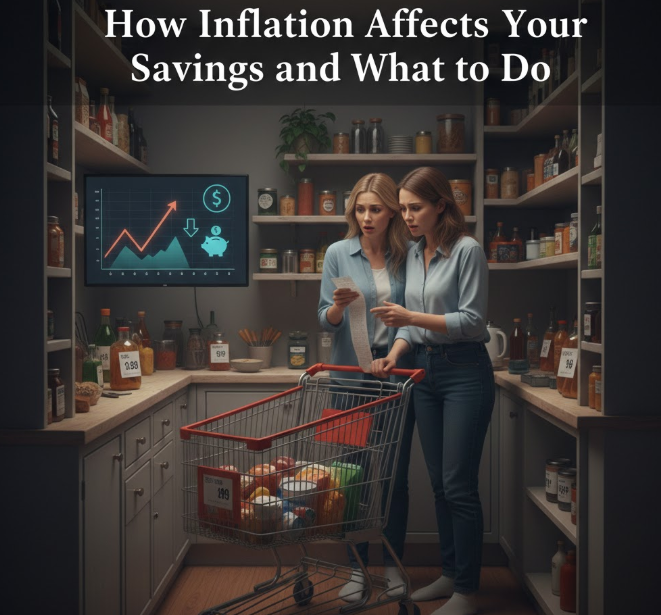
Infographic Summary: Inflation vs. Savings
Impact of Inflation on $10,000 at 5% Inflation Rate
- Year 1: $9,500
- Year 5: $7,734
- Year 10: $5,987
Smart Moves:
- Invest in TIPS
- Stocks or mutual funds
- Real estate
- Precious metals
- High-yield accounts
Final Thoughts: Protect Your Money Before It Loses Value
Inflation is inevitable, but its impact on your savings doesn’t have to be.
By understanding how inflation works and making smart investment choices, you can preserve and even grow your wealth over time.
Key Takeaways:
- Inflation reduces purchasing power, not your bank balance.
- Low-interest savings accounts may not keep up with inflation.
- Diversifying into stocks, bonds, real estate, or precious metals protects your wealth.
- Plan long-term and adjust contributions for rising costs.
Start today. Even small adjustments in how you save and invest can protect your money from inflation’s hidden effects.